Why Businesses Are Shifting to Unified Endpoint Management Solutions
mar 10, 2026 | Laxmi G Joshi
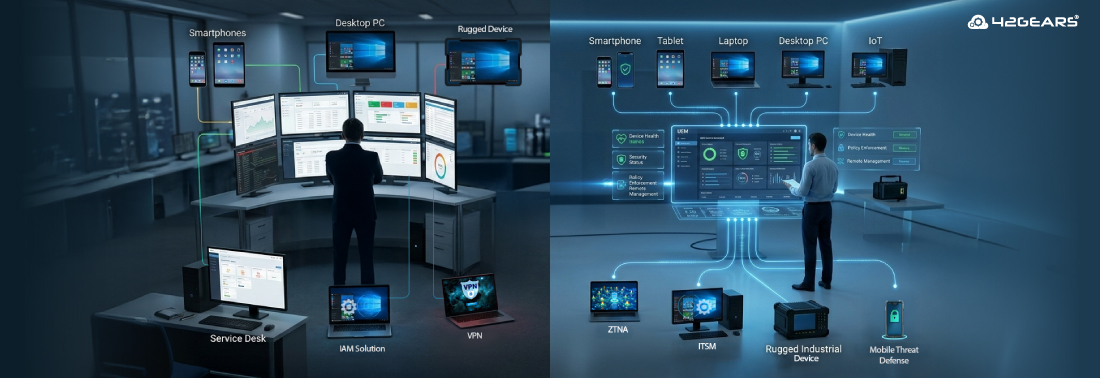
The modern workplace no longer fits inside office walls. Employees today work from homes, cafés, client sites, and across time zones—using both company-owned and personal devices such as laptops, smartphones, and tablets. While this flexibility boosts productivity, it has made IT management far more complex.
Traditional endpoint management solutions were designed for a time when businesses only had to manage desktops connected to a local network. Today’s work environments are far beyond local networks.
The Problem with Traditional Endpoint Management Solutions
Traditional endpoint management software relies on multiple separate tools: Mobile Device Management (MDM) for smartphones and tablets, desktop and PC Management solutions, ITSM tools for support tickets, Identity and Access Management (IAM) solutions like SureIdP, Zero Trust Network Access (ZTNA) solutions like SureAccess, and security solutions such as Mobile Threat Defense (MTD) for threat protection.
Using disconnected tools creates several challenges, including:
- Complexity in managing multiple operating systems (Windows, macOS, iOS, Android, Linux)
- Limited visibility across devices
- Inconsistent security policies
- Higher IT workload and costs
- Slower onboarding and device troubleshooting
- Increased security gaps and compliance risks
- Delayed patching and software updates
- Scalability issues as the organization grows
As businesses adopt cloud applications, remote work models, and BYOD (Bring Your Own Device) policies, this fragmented approach not only increases operational inefficiencies but also exposes organizations to greater security and compliance risks.
So, what's the solution? It is Unified Endpoint Management (UEM).
What is Unified Endpoint Management (UEM)?
Unified Endpoint Management (UEM) is a centralized platform that allows IT teams to secure, manage, and monitor all devices—regardless of operating system or location—from a single console. In essence, it brings every endpoint under unified control.
The global Unified Endpoint Management market size was valued at about USD 11.9 billion in 2024 and is expected to grow to USD 145.62 billion by 2031, at a rapid CAGR of around 40.5%1.
This rapid growth clearly demonstrates how critical UEM solutions have become for modern IT infrastructure.
UEM solutions such as SureMDM enable IT teams to apply consistent policies, enforce security controls, monitor devices, and track their location from a single interface. This unified approach simplifies administration, strengthens security, and improves the overall user experience.
Key Reasons Businesses Are Shifting to UEM
1. Centralized Control and Visibility
One of the biggest advantages of centralized device management is visibility. Traditional tools provide partial views of the IT environment, forcing admins to switch between consoles.
UEM solutions offer:
- A single, centralized dashboard
- Real-time visibility into all endpoints
- Unified policies for corporate and personal devices
This makes enterprise device management simpler, faster, and more reliable.
2. Enhanced Security and Compliance
Security is no longer about protecting a network perimeter—it’s about protecting identities, devices, and data everywhere.
UEM solution strengthens endpoint security management by enabling:
- OS Update Management, including Windows Automated Patch Management
- Data Loss Prevention (DLP) policies
- Device compliance enforcement
- Immediate remote wipe off sensitive data for lost or compromised devices
With over 57% of UEM deployments now cloud-based and embracing zero-trust security frameworks, organizations are better equipped to enforce consistent security policies across diverse environments 2.
With consistent security rules across all endpoints, businesses can significantly reduce cyber risks while maintaining compliance.
3. Cost Efficiency and Reduced IT Overhead
Managing multiple endpoint management software tools increases licensing costs, training expenses, and maintenance efforts. UEM software replaces these fragmented tools with one unified system.
UEM software benefits include:
- Lower software and infrastructure costs
- Reduced IT training requirements
- Decreased IT administrative overhead through centralized management
- Lower device provisioning and deployment costs
- Reduced device downtime and travel costs through faster remote troubleshooting
By consolidating tools, organizations gain a more cost-effective and scalable UEM solution.
4. Built for Remote and Hybrid Work
Remote and hybrid work are now standard, not exceptions. Traditional management tools depend heavily on local networks, making remote device management difficult.
Modern Unified Endpoint Management tools are remote-friendly, enabling:
- Seamless onboarding and offboarding for remote employees
- Secure Mobile Application Management and file transfers
- Remote support for easy troubleshooting and updates
- Real-time device monitoring regardless of location
- Verified and controlled access to corporate resources with SureAccess and SureIdP
This ensures business continuity, strengthens security, and delivers a seamless digital experience for employees—no matter where they work.
5. Improved Employee Experience
A strong IT system should support employees—not slow them down. UEM improves user experience through:
- Automated device onboarding, including remote onboarding
- Self-service app catalogs
- Seamless access to approved business applications and documents
- Faster issue resolution through remote control
- Secure BYOD enablement without compromising user privacy and corporate data security
When devices are configured correctly from day one and managed proactively, employees can focus on their work instead of IT disruptions—leading to higher productivity and satisfaction.
6. Support for Diverse Device Ecosystems
Modern workplaces use a mix of Windows, macOS, iOS, Android, and IoT devices. Managing them separately creates gaps in security and control.
UEM software supports:
- Laptops and desktops
- Smartphones and tablets
- BYOD devices
- Kiosks, rugged devices, wearables, and IoT endpoints
By managing every device from a single platform, businesses eliminate operational silos and ensure consistent security across their entire digital ecosystem.
Traditional vs. Unified Endpoint Management
| Feature | Traditional Management | Unified Endpoint Management (SureMDM) |
| Device Scope | Limited to specific device types (PCs or mobiles) | All endpoints: PCs, mobiles, BYOD, kiosks, IoT, wearables |
| Management Console | Multiple, disconnected tools | Single centralized dashboard |
| Security Model | Perimeter-focused, inconsistent policies | Zero Trust, identity-centric, unified policies |
| Deployment | LAN-dependent, On-premises heavy | On-premise, Cloud-based, remote-first |
| User Experience | Manual onboarding, high IT dependency | Automated onboarding, self-service options |
| IT Operations | High administrative effort, tool sprawl | Simplified operations, reduced workload |
| Scalability | Difficult to scale for new devices | Easily scales across devices and locations |
| Cost Impact | Higher licensing and training costs | Lower total cost through consolidation |
Choosing the right UEM software goes beyond features. Organizations should ensure the UEM solution supports all required endpoints, enforces strong security and compliance, and scales with future growth. The right endpoint management software aligns with business goals while simplifying IT operations.
Final Thoughts
As workplaces become more digital, distributed, and device-driven, traditional endpoint management can no longer keep up. Unified Endpoint Management offers a smarter way forward—combining security, efficiency, and flexibility into a single platform.
For businesses looking to simplify operations, improve security, and support modern workstyles, moving to a UEM solution is not just an upgrade—it’s a necessity.
Sources :
1: Verified Market Research
2: Industry Research
Upgrade your device management
strategy with a powerful UEM solution
Subscribe for our free newsletter

Exclusive News and Updates on Enterprise Mobility!