Remote Device Testing: A Smarter Strategy for Distributed Dev/QA
Jan 27, 2026 | Harshita B
Last Updated: Mar 02, 2026

At a Glance: Why Your Distributed Team Needs a Private Device Farm
- The Logistics Problem: Shipping physical hardware to distributed engineers is slow, expensive, and a major security risk.
- The Modern Solution: Remote device testing via a private farm (like AstroFarm) turns your hardware into a digital asset accessible from anywhere.
- Unique Advantage: Access ruggedized handhelds and unreleased prototypes that public clouds don't offer.
- The Bottom Line: Achieve higher device utilization, zero shipping costs, and significantly faster release cycles.
Let’s be honest: the way your team handles hardware probably feels a bit broken.
In the old days, your QA engineers could just walk over to a shared cabinet, grab a Google Pixel or an iPad, and get to work. But as your team has become distributed—spanning different cities, time zones, and continents—that "cabinet" has vanished.
If you’re still trying to manage testing by FedEx-ing handsets across the country, you’ve realized by now that for distributed teams like yours, the traditional way of handling hardware is a logistical nightmare.
Remote Work is the Permanent Future
We’ve moved past the "temporary" phase of remote work; it is now the standard operating procedure for the world’s most innovative engineering teams. Your best talent might be in Bangalore, Berlin, or Austin, and they all need access to the same hardware at the same time.
The companies that will win in the next decade are those that stop treating remote work as a hurdle and start building infrastructure that makes location irrelevant. If you are leading a testing or development team, mastering remote device testing isn't just a convenience—it’s a competitive necessity.
Remote device testing is the practice of accessing and executing manual or automated tests on physical devices located in a different geographical area. It allows your QA team to verify app performance, UI, and functionality on real hardware without needing that hardware physically present on their desks.
Why Your Team Needs a Private Farm for Remote Device Testing
1. Test the "Untestable": Rugged and Unreleased Devices
Most public device clouds focus on the latest consumer iPhones or Samsung Galaxies. But what if your team builds software for specialized industries?
Whether you need to perform remote device testing on ruggedized devices (like Zebra or Honeywell) used in warehouses, or you have pre-release prototypes that must remain strictly confidential, public farms can't help you. A private device farm allows you to plug your own specialized hardware into your private device cloud, making niche or unreleased models accessible to your entire global team instantly and securely.
A device farm is a centralized repository of real mobile devices—smartphones, tablets, and rugged handhelds—connected to a platform that allows developers and testers to access and control them via the cloud.
2. Stop Shipping, Start Sharing
With a private device farm, you don't ship hardware; you ship access. You can plug your devices into a central hub at the office (or even at an engineer's home) and "enroll" them into your private cloud. A tester in London can instantly take control of a tablet in San Francisco, perform a manual test, and release it for a dev in Tokyo—all in the same hour. This is the ultimate way to empower a distributed team.
3. Real Hardware, Real Results
You know that emulators and simulators only get you 80% of the way there. To truly sign off on a release, your QA team needs to see how the app handles real-world battery drain, CPU spikes, and data usage. A private device farm provides the accuracy of physical hardware with the high-speed convenience of the cloud.
4. Remote Debugging Without Borders
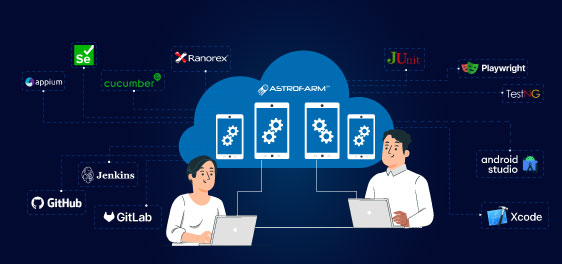
When a bug pops up, your developers shouldn't have to guess what happened based on a screenshot. AstroFarm allows your devs to connect a remote device directly to their local IDE (like Android Studio). They can step through code and inspect variables on a device that is physically located on the other side of the planet, making remote device testing and debugging a seamless experience.
Why AstroFarm is the Right Choice for Your Team
AstroFarm isn't just a tool; it’s a scalability engine for your QA department. Unlike rigid public clouds, AstroFarm is a flexible solution that allows you to build a farm that fits your specific needs.
- Contribute from Anywhere: Any user can plug in a device and contribute it to the farm.
- Full Automation Support: Your team can run massive Appium or Selenium test suites across your entire fleet of devices simultaneously.
- Total Security: You keep your data within your own infrastructure, ensuring your IP stays protected.
The future of engineering is distributed. It’s time your hardware strategy caught up.
Frequently Asked Questions
How does this help my team if we are all in different time zones?
Time zones become an advantage. A private device farm allows for "Follow-the-Sun" testing. Your team in India can use the devices all day, and as they log off, your US team can take over the same hardware. You get 100% utilization of your assets.
Can we test rugged devices or proprietary hardware?
Yes! This is one of AstroFarm’s biggest strengths. Because you provide the hardware, you can include ruggedized handhelds, POS devices, or unreleased prototypes that are not available on public platforms like BrowserStack or AWS.
Is there a lag when controlling devices during remote device testing?
AstroFarm uses high-performance streaming protocols. While there is always a small bit of network latency, it is optimized to feel as close to "device-in-hand" as possible, making it perfect for both manual testing and debugging.
How does this compare to a public device cloud?
Public clouds are expensive, and you don't own the hardware. AstroFarm gives you a private environment where you own the devices, pay no hourly usage fees, and have much tighter control over security—especially critical for unreleased models.
Rethink Device Sharing with AstroFarm
Subscribe for our free newsletter

Exclusive News and Updates on Enterprise Mobility!